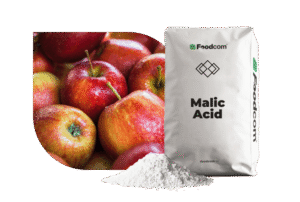


Malic acid is a versatile chemical compound used across many industries – from food and cosmetics to pharmaceuticals. Designated as E296, it is distinguished by its broad spectrum of action and beneficial properties, which account for its popularity. Find out exactly what malic acid is, what properties it has, and where and how it is used.
What is malic acid and how is it formed?
Malic acid is an organic chemical compound belonging to the group of dicarboxylic hydroxy acids. It occurs naturally in fruits, particularly in apples, from which it takes its name. In the food industry, it is designated as E296 and serves as an acidity regulator and flavor enhancer. It is obtained through both natural methods (extraction from plant materials) and synthetic methods – most commonly through the hydration of maleic anhydride.
The industrial production process allows for a high purity of the compound, which is crucial for its applications in industries such as food, pharmaceuticals, and cosmetics. In this form, it is often available as powdered malic acid, which is characterized by good solubility and stability.
Properties of malic acid
Malic acid is distinguished by a number of important physicochemical and biological properties. First and foremost, it is a substance with moderate acidity, which makes it milder than citric acid, yet effective in regulating pH. Its properties include:
- antioxidant activity, supporting the neutralization of free radicals,
- the ability to chelate metal ions,
- improving the taste of products by giving them a fresh, slightly sour note,
- participation in the Krebs cycle, making it an important metabolic compound.
Thus, E296 is widely used in both the food industry and food technology.

The use of malic acid in the food industry
One of the main areas of application for malic acid is the food industry. Its use includes the production of beverages, confectionery, and baked goods. In the baking industry, it acts as an acidity regulator and improves the structure and shelf life of products. In particular, it is used as an ingredient in baking ingredients, where it affects dough stability and improves the sensory qualities of finished products. Additionally, it helps extend the freshness of baked goods by limiting microbial growth.
Malic Acid in Cosmetics
Malic acid is gaining increasing importance in cosmetics, where it is used as an ingredient in skincare and dermatological products. It belongs to the group of alpha-hydroxy acids (AHAs), which are known for their exfoliating properties. Its effects include:
- gently removing dead skin cells,
- improving skin texture,
- stimulating cell renewal,
- lightening of discoloration.
Its milder action compared to other AHAs makes malic acid suitable for use in products designed for sensitive skin. In this industry, it functions as one of the most important ingredients in the category of cosmetic raw materials, used in the production of creams, scrubs, and serums.
Applications of malic acid in other industries
Beyond the food and cosmetics industries, malic acid is also used in pharmaceuticals and the chemical industry. In pharmaceutical preparations, it can serve as an excipient that improves the bioavailability of active ingredients. In the chemical industry, it is used as an ingredient in cleaning agents and as a pH regulator in various technological processes. Its biodegradability makes it considered a relatively environmentally friendly substance.
Where to buy malic acid and what to look for?
In Poland, one of the suppliers of malic acid is the FDCM platform, which offers products that meet rigorous quality standards and are used in many industries. When choosing, pay attention to:
- purity grade (food-grade, cosmetic-grade, technical-grade),
- form (powder, solution),
- quality certificates,
- compliance with industry standards.

Development prospects and innovative applications of malic acid
In recent years, interest in malic acid has been growing as an ingredient that aligns with the trend toward sustainable production and so-called “green chemistry.” Its natural origin and the ability to produce it through biotechnological processes mean that it is increasingly replacing more aggressive or less environmentally friendly chemicals. In practice, this means the development of new fermentation methods that use microorganisms to produce malic acid from renewable plant-based raw materials.
Another significant area of research is the application of this compound in functional food technology. Due to its role in the body’s metabolic processes, malic acid supports energy production at the cellular level, making it an interesting addition to dietary supplements and beverages for physically active individuals. At the same time, analyses are being conducted on its impact on the bioavailability of minerals, which is significant in the design of modern nutritional formulations.
The importance of malic acid in modern technology
Malic acid plays a significant role in modern technological processes thanks to its versatility and safety of use. Growing interest in natural and functional additives means that the importance of E296 will continue to rise. Its wide range of applications, from food to cosmetics, makes it one of the most versatile organic acids used in the modern economy.