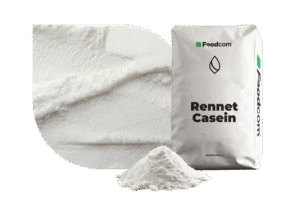


Rennet casein is one of the most important milk proteins, obtained from cow’s milk through the action of coagulating enzymes. Unlike other protein fractions, its structure forms under conditions similar to the natural process of milk curdling, which contributes to its unique functional properties. It most commonly appears as a fine, light-colored powder with a neutral taste and odor. Its high protein content and low fat and lactose levels make it a valued raw material in many food processing industries.
How is rennet casein produced?
The process of obtaining this protein begins with the selection of high-quality milk, which is then pasteurized. The most important step is the addition of rennet—the enzyme responsible for the coagulation of milk proteins. The enzyme causes the milk to form a curd, which is then separated from the whey. The curd is then rinsed, purified, and dried, resulting in a stable powder with a uniform structure. The entire technological process resembles the natural mechanisms involved in cheese production, but it is precisely controlled to ensure consistency and high quality of the final product.
Rennet Casein – Properties and Characteristics of the Protein
Depending on the processing parameters, rennet casein exhibits high elasticity, the ability to form stable structures, and very good fat- and water-binding properties. It is distinguished by a set of characteristics that determine its wide range of applications:
- high protein content (up to approx. 90%),
- low fat and milk sugar content,
- the ability to form stable gels,
- very good fat emulsification,
- high structural elasticity,
- slow release of amino acids,
- neutral taste and odor.
These properties make rennet casein a functional ingredient used in both food products and more advanced industrial formulations.
Differences Between Rennet-Treated and Acid-Treated Casein—What to Look For?
There are two main types of casein on the market: rennet-treated and acid-treated. Acid-treated casein is characterized by higher purity and a more neutral sensory profile. Rennet-treated casein, on the other hand, offers better elasticity, resilience, and fat-binding capacity. For this reason, different types of milk proteins have distinct applications—some are well-suited for dietary supplements, while others are ideal for traditional cheese-making.
Rennet-Coagulated Casein in Cheese Making
The most well-established use of rennet casein is in the cheese-making industry. This stems directly from its method of production, which mimics the natural process of milk curd formation. In practice, it is primarily used in the production of aged and semi-hard cheeses, where the structure and elasticity of the final product are crucial. Thanks to its properties, it enhances the cohesion of the cheese curd, improves its elasticity, and helps achieve the desired texture.
Dairy Products and Functional Foods
In addition to cheeses, rennet casein is used in the dairy industry at large. It is utilized in products where stability and the right consistency are essential. It can be found, among other things, in dairy desserts, high-protein yogurts, and milk blends with increased protein content. It improves creaminess and density and reduces separation of the product during storage.
An Ingredient in Dietary Supplements and Functional Foods
Due to its high protein content and slower digestion rate, rennet casein is also used in the dietary supplement industry. It is used in “slow-release” protein supplements, which deliver amino acids gradually over an extended period. In this way, it supports the body’s recovery process, particularly at night. In this market segment, it is often combined with other milk protein fractions that have slightly different technological and sensory properties.
Pharmaceuticals – Casein as a Carrier for Active Ingredients
In the pharmaceutical industry, rennet casein primarily serves as an excipient. It is used as a carrier for active ingredients and as a component of controlled-release systems. Its natural origin, biodegradability, and ability to form stable structures make it an attractive material for innovative pharmaceutical solutions.
Applications in Cosmetics and Other Industries
Casein is also appearing more and more frequently in cosmetic products. Its moisturizing and protective properties make it suitable for use in skin and hair care products. It helps maintain proper moisture levels and improves the elasticity of the epidermis, making it an attractive ingredient in natural cosmetic formulations.
Role in modern processing and trade
The modern market for dairy raw materials is increasingly relying on digital solutions. One example is the FDCM.eu platform, where you can find high-quality ingredients for dietary supplements. Such solutions facilitate purchasing, comparing specifications, and managing deliveries in a B2B model, which significantly streamlines manufacturers’ operations.
Milk protein, the driving force behind many industries
Rennet casein is a versatile milk protein with high technological value. It combines beneficial functional properties, stability, and a wide range of applications—from the food industry, through dietary supplements, to the pharmaceutical and cosmetics sectors. Its unique characteristics make it one of the most important raw materials used in modern dairy processing, as well as in related industries.