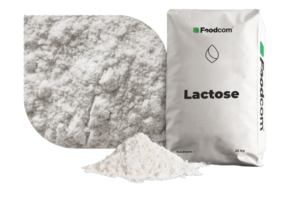


Lactose is one of the most important sugars of dairy origin, which for many years has played an important role in various industries – from food to pharmaceuticals to cosmetics. Although it is commonly associated with milk and dairy products, in practice it is an extremely versatile substance with many technological properties. It is used wherever the texture of products, the stability of mixtures, a delicate sweetness or the ability to release ingredients in a controlled manner are important.
What is lactose? Brief characteristics
Lactose is a disaccharide naturally found in mammalian milk. It is made up of two molecules – glucose and galactose, which are linked by a β-1,4-glycosidic bond. Its main characteristic is its moderately sweet taste, much milder than that of ordinary table sugar (sucrose). In industry, lactose monohydrate, a form of monohydrate with a stable crystalline structure, is often found, valued for its predictable behavior in technological processes.
In the body, lactose has an energy function and provides galactose, which is necessary for the construction of important structures in the mammalian body, including glycolipids and glycoproteins responsible for the proper functioning of cells. In order for it to be digested, an enzyme – lactase – is needed to break it down into glucose and galactose.
While lactose intolerance is mainly discussed in the dietary context, in industry its importance has a completely different dimension – primarily technological and functional.
How is lactose extracted? Step-by-step production process
Industrial production of lactose is a multi-step process that is relatively simple technologically. Lactose is extracted from whey created during the production of cheese or casein. It is the whey, which is rich in lactose, proteins and minerals, that is the starting point for further steps. Lactose production consists of the following steps:
- Separation of proteins and purification of whey – at this stage, proteins and fat are separated, leaving a solution rich in lactose. This is a good time to remind you what milk protein concentrate is. It is a highly processed product derived from whey or milk, containing concentrated proteins and used in functional foods and supplements.
- Concentrated lactose solution – purified whey is concentrated by evaporating water. The process achieves a concentration at which sugar crystallization is possible.
- Crystallization – the concentrated solution is cooled and stirred, which initiates the precipitation of lactose crystals. Their size, shape and quality depend on the process conditions – time, temperature or intensity of stirring.
- Separation of crystals and drying – the crystals are separated from the remaining liquid using centrifuges and then dried, producing pure, free-flowing lactose of high purity.
- Grinding and standardization – finally, the lactose is ground to the appropriate granulation – from very fine, used in tablets, to coarser fractions used in food.
The above process yields a product that is stable, homogeneous and free of impurities, ideal for technological applications.

Properties of lactose – why is it so valuable?
Lactose is distinguished by a unique set of characteristics that make it one of the most versatile raw materials in the industry. The most important of these include:
- mildly sweet taste – it is only about 20 – 30% the sweetness of sucrose, making lactose ideal where high sweetness is not the issue, but a balanced flavor profile (e.g., in sports nutrition, modified milk, baked goods),
- high hygroscopicity – lactose absorbs moisture from the environment, stabilizing the structure of powder mixtures and positively affecting the texture of foods,
- ability to form crystals – the crystalline form of lactose is important in the production of milk bars, caramel, powdered milk or infant formula, among others,
- low solubility – unlike sucrose, lactose dissolves more slowly, which allows for the gradual release of active ingredients in pharmaceuticals and limits the rapid hardening of candy,
- flavor and aroma neutrality – lactose does not dominate other ingredients, so it is used as a carrier for flavors or active ingredients,
- microbiological safety and purity – lactose undergoes intensive purification processes, so it meets strict industry standards.
The use of lactose in the food industry
Food grade lactose is one of the most important ingredients used in food production technology. Its properties make it possible:
- improving the texture of dairy products – in yogurt, ice cream and cheese, lactose is responsible for the right texture and natural sweetness,
- stabilizing powdered mixtures – it is added to powdered milk, sports nutrition, breakfast cereals and even condiments and instant sauces,
- production of bread and baked goods – lactose improves the blushing of the crust (Maillard reactions) and increases the moisture content of baked goods,
- the production of confectionery products – it is essential in the production of milk caramels, candy bars and fudge pastes, providing them with a characteristic taste and stability,
- manufacture of modified milk and baby foods.
Due to its properties, it is a standard ingredient in milk mixtures.
Applications of lactose in pharmacy
In the pharmaceutical industry, lactose is one of the most widely used fillers for tablets and capsules. Its importance is due to several reasons:
- it ensures adequate volume of the tablet,
- stabilizes the active substance,
- improves the flowability of mixtures,
- allows precise dosage of ingredients,
- is safe, chemically inert and well tolerated.
It is used in monohydrate or anhydrous form, depending on the requirements of the formulation.
Lactose in the cosmetic industry
In cosmetics, lactose acts as a mild humectant, i.e. a substance that binds water in the epidermis. It is added to, among other things:
- moisturizing creams,
- skin care masks,
- enzymatic scrubs,
- body lotions.
Thanks to its structure, it mixes well with other raw materials and stabilizes cosmetics with a delicate formula.

Lactose in the production of supplements and sports dietetics
In the supplement industry, lactose serves as a carrier of flavors, vitamin substances and minerals. Its presence influences:
- homogeneity of mixtures,
- better solubility of powders,
- flavor and aroma stability of products.
As a result, it is often found in protein supplements and multivitamin supplements.
One supplier of raw materials to the industry is the FDCM platform, where 25 kg lactose with a minimum of 99% lactose is also available. It is ideal for food and pharmaceutical manufacturers requiring high purity components.
Why is lactose such a valuable raw material?
Lactose is not just an ingredient of milk – it is an important technological raw material, which, thanks to its properties, is used in many industries. It is stable, safe, versatile and easy to process. It works great as a carrier, a stabilizer, an ingredient that improves the texture of products and a sweetness regulator in food.
In pharmaceuticals, it enables the precise production of tablets and capsules, and in cosmetics it improves the moisturizing properties of cosmetics. Thanks to its relatively simple and efficient extraction process and excellent functionality, it remains one of the most important raw materials in many industries.