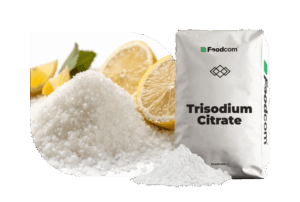



Trisodium Citrate – Characteristics and Role in Industry
Trisodium citrate is an ingredient commonly used in many everyday products—from food and cosmetics to pharmaceutical preparations. Its versatile properties make it one of the most widely used additives in modern manufacturing processes. Learn about the key properties and uses of trisodium citrate.
What is trisodium citrate?
Trisodium citrate, commonly known as sodium citrate, is the sodium salt of citric acid. It occurs as a white, crystalline powder that is highly soluble in water, which significantly facilitates its use in various types of liquid and semi-liquid formulations. It is characterized by high chemical stability and the ability to form stable systems in the products in which it is used. It belongs to a group of substances known as regulators, which are responsible for pH control and product stabilization in various industries. Furthermore, it helps maintain a uniform product structure. In the food and cosmetics industries, it also functions as a food additive designated as E331.
Another significant characteristic of trisodium citrate is its ability to bind metal ions, which helps limit undesirable reactions in products and supports the maintenance of their quality during storage. For this reason, it is used in many industries where consistency and control of the physicochemical parameters of finished products are essential.

Physical and Chemical Properties of Trisodium Citrate
Trisodium citrate is a white, crystalline powder with a neutral odor and a slightly salty taste. A characteristic feature is its very good solubility in water, which allows it to easily integrate into various aqueous and semi-aqueous systems. From a chemical standpoint, it acts as an acidity regulator and a metal ion chelating agent. This property is of great importance in stabilizing products in which the presence of metal ions could lead to undesirable oxidation reactions or discoloration.
Applications of Trisodium Citrate in the Food Industry
One of the main areas of application for this compound is the food industry. There, trisodium citrate primarily serves as an acidity regulator and flavor stabilizer. It is used in the production of beverages, processed cheese, dairy products, desserts, and sauces. Its presence helps achieve the right flavor balance and a stable structure in the final product. In many recipes, it also improves texture and consistency, which is particularly important in processed products. Additionally, it helps maintain the homogeneity of emulsions by preventing them from separating.
Use in the Pharmaceutical Industry
In the pharmaceutical sector, trisodium citrate is primarily used as an ingredient that supports the stability of formulations and regulates their pH. It is used in syrups, oral solutions, and electrolyte preparations. Its ability to bind metal ions helps limit undesirable chemical reactions, which is important for the stability and quality of medicinal products. In this way, it helps maintain the appropriate physicochemical parameters throughout the product’s shelf life.
Role in Cosmetics and Household Chemicals
Trisodium citrate is also a valued ingredient in the cosmetics industry. It is used in cleansing gels, shampoos, emulsions, and skin care products. Its primary function is to stabilize cosmetic formulations and regulate pH, which enhances user comfort and product shelf life. Additionally, it supports the action of other active ingredients, improving their effectiveness. In household chemicals, it is used as an ingredient in detergents and cleaning agents, where it softens water and enhances the effectiveness of surfactants.
Sodium Citrate – Importance in Technological Processes
Trisodium citrate plays a significant role in modern manufacturing processes where precise control of physicochemical parameters is essential. Thanks to its versatility, it can be used under various process conditions without losing its valuable properties. Its ability to complex metal ions and regulate pH makes it particularly valued in production that requires high repeatability and quality. Furthermore, its ease of dosing and good solubility contribute to its widespread use in industry.
Trisodium citrate is available from specialized suppliers of chemical raw materials, such as FDCM.eu, where we supply components for the food, cosmetics, and chemical industries.
Trisodium citrate (E331) – functionality in manufacturing
Trisodium citrate (E331) is a versatile raw material with high technological value that is used in many industries. Its physicochemical properties—such as good solubility, the ability to regulate pH, and the capacity to complex metal ions—make it an essential component of modern formulations.
The development of modern production technologies means that ingredients of this type are playing an increasingly important role in the design of stable and reproducible formulations. As a result, it remains a key element in many processes where control and predictability of raw material performance are critical.