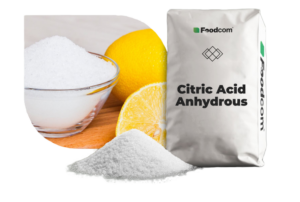



Citric acid is one of the most versatile and widely used compounds in the food, pharmaceutical, chemical, and cosmetic industries. Although the name often brings to mind household uses, E330 is actually one of the basic functional additives used in many industries. How does anhydrous citric acid differ from monohydrate citric acid and what are its practical applications?
Monohydrate citric acid – characteristics and function in industry
Citric acid is available on the market in two forms – as monohydrate and anhydrous acid. Both types have almost identical chemical structures, but differ in the presence (or absence) of a water molecule. This seemingly minor difference affects the way the substance is used, its stability, physical properties, and compatibility with other ingredients in a given recipe.
Monohydric citric acid contains one water molecule in its crystal structure. It occurs as a fine, white powder that is highly soluble in water. Thanks to this, and due to its mild taste, this organic acid is widely used in the food industry, where it acts as an acidity regulator, preservative, and flavor enhancer.
In food products, citric acid monohydrate is found primarily in non-alcoholic beverages, jellies, jams, yogurts, sweets, and functional foods. Its pH-lowering properties support the microbiological stability of products, extend their shelf life, and improve their flavor profile. It is also used in the production of dairy products, e.g. as a protein coagulation aid in processed cheese and fermented beverages.
In the pharmaceutical industry, monohydric citric acid is used as an ingredient in effervescent medicines, vitamin preparations and soluble tablets. It stabilizes solutions and improves the bioavailability of active ingredients. In household chemicals, it is used as a pH regulator and an ingredient in detergents and cleaning agents, especially those with descaling properties.

Anhydrous citric acid – when is it better?
Anhydrous citric acid, as the name suggests, does not contain water molecules in its structure. It is produced by dehydrating the monohydrate form at a temperature of about 78°C. It has similar chemical properties but differs slightly in its physical behavior – it has a lower molecular weight, greater stability in dry conditions, and lower hygroscopicity, which means that it absorbs moisture from the environment much more slowly.
The anhydrous form is particularly valued in industries where moisture control is important. In food production, it is mainly used in dry mixtures, such as spices, instant meals, powdered supplements, and freeze-dried products. Its presence does not affect the water content of the recipe, making it an ideal choice where shelf life and crispness are important.
In pharmacy, anhydrous citric acid is used, among other things, in the production of tablets, powders for suspensions and granules with prolonged release. As a stabilizer, it is also used in cosmetics in powder form, e.g. in masks, scrubs and dry shampoos.
Interestingly, in the technical industry, anhydrous citric acid is also used as a cleaning agent for household appliances due to its strong descaling properties. In the textile and electroplating industries, it is used as a metal ion chelator.
Differences that matter in practice
Although from a chemical point of view, the differences between monohydric and anhydrous citric acid may seem marginal, in industrial reality they have specific consequences. First and foremost, it is about interaction with water – the presence of crystalline water affects hygroscopic properties, behavior under various storage conditions, and the dosage weight at fixed proportions in the recipe.
The monohydrate form works best in aqueous and semi-liquid products, especially where rapid and complete solubility is important. The anhydrous version, on the other hand, is mainly used in dry formulations that require moisture control and avoidance of reactions with water.
Where to source high-quality citric acid?
Choosing a raw material supplier in the B2B model is not only a matter of price, but also of quality, timely delivery, and access to documentation. The FDCM.eu platform offers both monohydrate citric acid and anhydrous citric acid, as well as a wide selection of functional additives used in the food and pharmaceutical industries.
The option to order samples with delivery allows companies to test selected food raw materials online in laboratory conditions or pilot production before purchasing larger batches. This is a practical solution that reduces the risk associated with introducing new ingredients into technological processes.

How to choose the right form of E330 and where to buy proven food raw materials online?
Monohydrate citric acid and anhydrous citric acid are two forms of the same chemical compound – E330 – but they differ in their properties and applications. The monohydrate form is best suited for liquid products, where solubility and ease of mixing are important.
The anhydrous form, on the other hand, provides greater stability and is suitable for dry recipes that require longer shelf life and moisture resistance.
The choice of the right variant depends not only on the end use, but also on the production, storage, and distribution conditions. If your company is looking for a reliable supplier of raw materials, visit FDCM.eu and take advantage of a wide range of functional additives, available online with fast shipping. With samples delivered to your door, you gain full control over the quality and compatibility of the raw materials in your production process.