Description

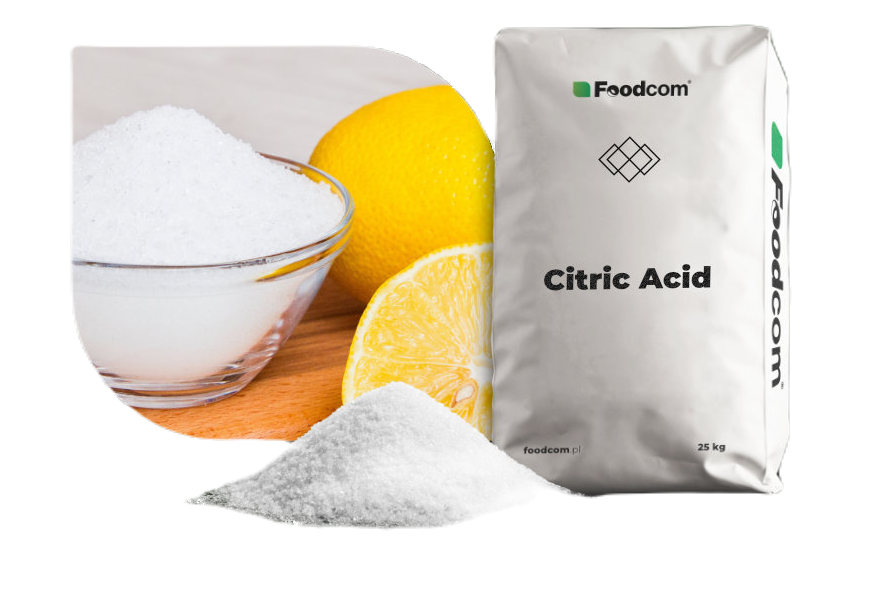
Citric Acid occurs naturally in citrus fruits such as lemons, oranges, black currants, strawberries, and pineapples. Citric Acid is also found in most organisms, where it plays an important function in the burning of carbohydrates. It can also be produced chemically – industrially it is mainly produced by fermentation or chemical reaction. It is used in about 90% of the world’s production and is produced by fermentation using enzymes and strains of bacteria, most commonly Aspergillus niger. It can occur as Citric Acid monohydrate or anhydrous.

Technical aspects

As an acidity regulator, citric acid lowers pH levels, providing a preservative effect that extends the shelf life of food and feed products. It enhances sour flavors, acts as an antioxidant, and serves as an emulsion stabilizer, preventing fat separation. Thanks to its whitening and stabilizing properties, it is used not only in food and feed but also in industrial processes requiring pH control and product stability.

Application

Citric Acid as a food additive functions as E330. It is an excellent preservative added to canned and preserved products to keep them fresh. It also serves as a binder and thickener in sauces, creams, jellies, jams and marmalades. In confectionery and baked goods, it improves the leavening power of the baking soda. It is also an important ingredient in cheese and beer production.

Citric Acid is also used in other industries, including as a water softener in detergents and soaps and as a fertilizer in agriculture. It is also added to feeds – the addition of Citric Acid has been shown to have a positive effect on broiler performance and bone mineralization, as well as better growth in weaners. In addition, thanks to citric acid, feed stays fresher longer and is tastier for the animals, which contributes to weight gain.

In the pharmaceutical industry, it is found in dietary supplements and in the formulation of drugs. Citric Acid masks their bitter taste, also has effervescent properties and stabilizing functions.

Citric Acid is also widely used in the manufacture of cosmetics. Since it has a whitening effect, it can be found in cosmetics for blemished skin. In addition, it acts as an antioxidant and prolongs the shelf life of cosmetics. Cosmetics also benefit from the fact that citric acid smoothes wrinkles and has an exfoliating effect.

Storage

The shelf life of Citric Acid is approximately 3 years. The product should be stored in a dry, cool warehouse

Package

Foodcom S.A. offers Citric Acid in 25 kg bags.

Citric Acid

2,07EUR/kg

Shipping fee not included.

1,97EUR/kg (5% off)
min. 10 kg
1,86EUR/kg (10% off)
min. 20 kg
1,76EUR/kg (15% off)
min. 40 kg
1,66EUR/kg (20% off)
min. 100 kg
Minimal order
5 MT
Stock
Available
Recalculate shipping
Total:
Each:
Total:
Each:
Order more

We offer a delivery option by prior arrangement. Contact the logistics department for an individual offer.

Ask for a sample

Customer support

Ask for a product

Delivery

We ship orders across the EU to the address you provide. For individual offers or personal pickup from our warehouses, please contact our logistics team: +48 577 494 140

We also deliver samples, Foodcom Creatine/MSM, and other ready-to-use consumer products both within Poland and abroad.

Description

Citric Acid occurs naturally in citrus fruits such as lemons, oranges, black currants, strawberries, and pineapples. Citric Acid is also found in most organisms, where it plays an important function in the burning of carbohydrates. It can also be produced chemically – industrially it is mainly produced by fermentation or chemical reaction. It is used in about 90% of the world’s production and is produced by fermentation using enzymes and strains of bacteria, most commonly Aspergillus niger. It can occur as Citric Acid monohydrate or anhydrous.

Technical aspects

As an acidity regulator, citric acid lowers pH levels, providing a preservative effect that extends the shelf life of food and feed products. It enhances sour flavors, acts as an antioxidant, and serves as an emulsion stabilizer, preventing fat separation. Thanks to its whitening and stabilizing properties, it is used not only in food and feed but also in industrial processes requiring pH control and product stability.

Application

Citric Acid as a food additive functions as E330. It is an excellent preservative added to canned and preserved products to keep them fresh. It also serves as a binder and thickener in sauces, creams, jellies, jams and marmalades. In confectionery and baked goods, it improves the leavening power of the baking soda. It is also an important ingredient in cheese and beer production.

Citric Acid is also used in other industries, including as a water softener in detergents and soaps and as a fertilizer in agriculture. It is also added to feeds – the addition of Citric Acid has been shown to have a positive effect on broiler performance and bone mineralization, as well as better growth in weaners. In addition, thanks to citric acid, feed stays fresher longer and is tastier for the animals, which contributes to weight gain.

In the pharmaceutical industry, it is found in dietary supplements and in the formulation of drugs. Citric Acid masks their bitter taste, also has effervescent properties and stabilizing functions.

Citric Acid is also widely used in the manufacture of cosmetics. Since it has a whitening effect, it can be found in cosmetics for blemished skin. In addition, it acts as an antioxidant and prolongs the shelf life of cosmetics. Cosmetics also benefit from the fact that citric acid smoothes wrinkles and has an exfoliating effect.

Storage

The shelf life of Citric Acid is approximately 3 years. The product should be stored in a dry, cool warehouse

Package

Foodcom S.A. offers Citric Acid in 25 kg bags.

111

Contact

Reach out to us!

Contact us by the contact form, and get a direct response to your question within four business hours!

Interested in selling your products on our marketplace
Peberdy William
Need a new supplier for your production?
Grammont Stevenson
Interested in a product not listed on the website?

Sign up for our newsletter to learn more about our products