Description

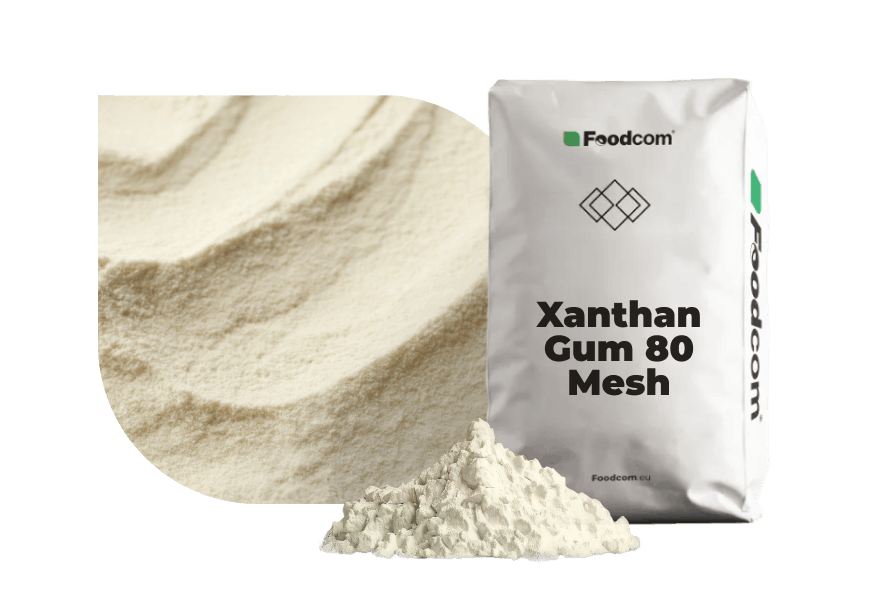
Xanthan gum is a natural biopolymer obtained by fermenting corn starch with the help of Xanthomonas campestris bacteria. It comes as a fine, white or slightly yellowish powder with a neutral smell and taste. It has excellent stabilising, emulsifying and thickening properties, even under extreme pH or temperature conditions.

Xanthan powder is widely used in the food, pharmaceutical, cosmetic and chemical industries. Thanks to its shear resistance and unique pseudoplasticity, it is ideal for products requiring a stable consistency, from sauces and dressings to gels and emulsions.

Technical aspects

Natural xanthan gum is characterised by high viscosity, good solubility and microbiological purity. It remains stable under a wide range of processing conditions.

Parameter Value
Appearance White or light yellow powder
Particle size (sieve) ≥95% through 80 mesh
Viscosity (1% KCl) 1200–1700 cP
Shear ratio (V1/V2) 1.02–1.45
pH (1% solution) 6.0–8.0
Loss on drying ≤15%
Ash ≤16%
Lead content (Pb) ≤2 ppm
Whiteness ≥50
Pyruvic acid ≥1.5%
Total nitrogen ≤1.5%
Yeast and moulds ≤100 cfu/g
Total number of microorganisms ≤2000 cfu/g
Salmonella Absent

Application

Xanthan gum is used as a natural stabiliser and texture modifier in food products such as sauces, soups, beverages and baked goods. Thanks to its resistance to temperature and pH changes, it is also suitable for gluten-free and dietetic products.

Outside the food sector, it is used in cosmetics, pharmaceuticals, and the chemical and mining industries, including in drilling muds and technical emulsions.

Storage

The product should be stored in its original packaging, in a dry, cool and well-ventilated place, away from toxic and corrosive substances.

Package

The product is available in paper bags, individual packages and big bags. Standard net weight: 25 kg.

Frequently Asked Questions

What does the 80 mesh designation mean in xanthan gum?
The 80 mesh designation refers to the particle size of the powder. In practice, this means the average granulation of the product, which affects how it is dosed, mixed, and the rate of hydration in liquids.
What is the difference between 80 mesh and 200 mesh xanthan gum?
200 mesh xanthan gum has finer particles than 80 mesh. The finer fraction usually hydrates faster and disperses more easily in liquids, while 80 mesh may be advantageous in some technological processes due to less dusting and easier dosing.
In what applications is 80 mesh xanthan gum used?
80 mesh xanthan gum is used in sauces, dressings, beverages, gluten-free products, and various food formulations requiring stabilization and viscosity control, among other things.
What technological functions does xanthan gum perform in formulations?
Xanthan gum acts as a thickener, stabilizer, and product structure improver. It can affect the viscosity, suspension stability, and texture of the final product.
Where to buy 80 mesh xanthan gum?
80 mesh xanthan gum can be purchased through the FDCM platform, which offers raw materials and ingredients used in food, supplements, and animal feed.