Description

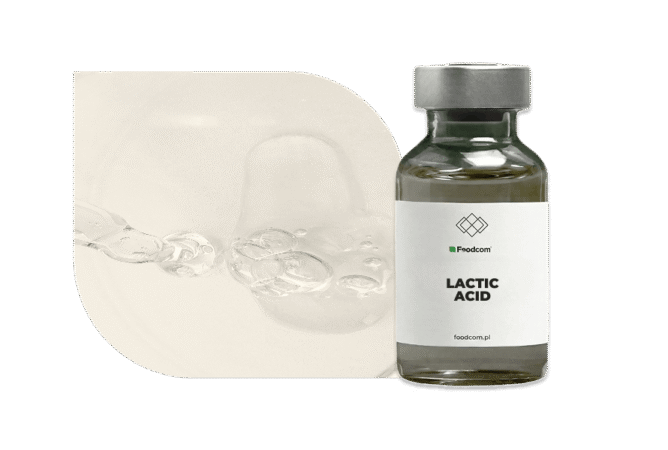
Lactic acid is an organic acid supplied as a transparent, syrupy liquid with a distinctly acidic taste. The product is colourless to slightly yellow and has no odour or only a faint characteristic smell. Due to its physicochemical properties and high stability, lactic acid is widely used across food, chemical and industrial applications.

Technical aspects

The acid is characterised by good solubility, low metal corrosiveness and non-flammable behaviour. It is commonly applied as an acidity regulator, processing aid and intermediate in various technological processes.

Parameter Value
Appearance Transparent, syrupy liquid
Colour Colourless or slightly yellow
Odour Odourless or slightly characteristic
pH < 1
Boiling point 122°C (1.85–2.0 kPa, 100%)
Melting point 53°C (100%)
Flammability Not flammable
Specific gravity 1.20 – 1.21
Viscosity 0.0369 Pa·s (25°C, 86.6% solution)
Solubility Miscible with water and alcohol
Metal corrosion rate Low – 1.14 mm/year
Shelf life 3 years

Application

Lactic acid is widely used in various industrial sectors, including:

  • food industry as an acidity regulator and processing aid,
  • chemical industry as an intermediate and functional additive,
  • industrial formulations requiring pH adjustment,
  • fermentation-based and biochemical processes,
  • technical applications where controlled acidity is required.

Storage

Lactic acid should be stored in its original packaging or in tightly closed containers. The product must be kept in appropriate storage conditions to maintain quality and stability throughout its shelf life.

Package

Product transported in IBC containers.

Frequently Asked Questions

What is lactic acid and how is it produced?
Lactic acid is an organic acid naturally formed during the fermentation of carbohydrates. In industrial production, it is typically obtained through the controlled fermentation of sugars derived from corn, sugar beet, or sugarcane. It is widely used in food, pharmaceutical, cosmetic, and industrial applications.
What are the main applications of lactic acid?
Lactic acid is primarily used as an acidity regulator, preservative, and pH stabilizer in the food industry (E270). It is also applied in cosmetics (for exfoliation and pH control), pharmaceuticals, animal nutrition, and as a raw material for producing biodegradable plastics such as PLA (polylactic acid).
Is lactic acid safe for food use?
Yes. Lactic acid (E270) is approved for use in food products worldwide and is considered safe when used according to regulatory guidelines. It occurs naturally in many fermented foods such as yogurt, pickles, and sourdough bread.
What is the difference between food-grade and technical-grade lactic acid?
Food-grade lactic acid meets strict purity and safety standards for use in food and beverage applications. Technical-grade lactic acid is typically used in industrial processes, cleaning products, or biodegradable material production, where food safety certification is not required.