Description

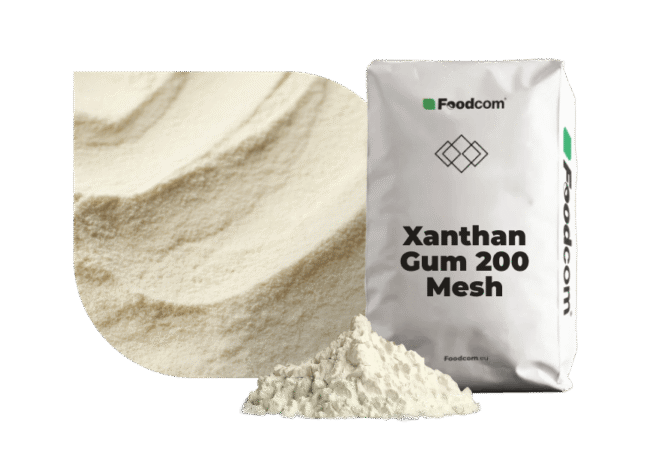
Xanthan gum 200 mesh is a natural biopolymer obtained by fermenting corn starch with Xanthomonas campestris bacteria. It has a very fine structure, which ensures rapid dispersion and excellent viscosity in aqueous solutions. The product is a white or light yellow powder with a neutral odour and taste.

Xanthan powder is distinguished by its high shear resistance and unique pseudoplasticity, making it a versatile ingredient for stabilising and thickening a wide range of food, cosmetic and industrial products. Its stability over a wide pH and temperature range increases its versatility.

Technical aspects

Xanthan gum 200 mesh is microbiologically safe and complies with quality requirements for food and industrial applications.

Parameter Value
Appearance White or light yellow powder
Particle size (sieve analysis) 99% through 80 mesh, 92% through 200 mesh
Viscosity (1% KCl solution) 1200–1700 cP
Shear ratio ≥ 6.5
V1/V2 1.02–1.45
pH (1% solution) 6.0 – 8.0
Moisture content (loss on drying) ≤ 15%
Ash ≤ 16%
Whiteness ≥ 50
Pyruvic acid ≥ 1.5%
Total nitrogen ≤ 1.5%
Yeast and moulds ≤ 100 cfu/g
Total number of microorganisms ≤ 2000 cfu/g
Salmonella Absent
Lead (Pb) ≤ 2 ppm

Application

Natural xanthan gum is used as a texture modifier and stabiliser in food – in sauces, soups, dressings and desserts. Its rheological properties allow the desired consistency to be achieved even at low concentrations.

In addition to the food industry, it is widely used in cosmetics, pharmaceuticals and household chemicals, as well as in industrial technologies such as oil drilling and the production of technical emulsions.

Storage

Store in a cool, dry, well-ventilated place, away from moisture and toxic substances.

Package

FDCM supplies xanthan gum 200 mesh in 25 kg and big bags.

Frequently Asked Questions

How does the particle size of 200 mesh affect the production process?
200 mesh xanthan gum has a fine fraction, which facilitates its even distribution in dry mixtures and faster hydration in liquids. In practice, this means better viscosity control and less risk of lumps forming during mixing.
How does 200 mesh xanthan gum behave in products with different pH levels?
Xanthan gum is stable over a wide pH range, so it can be used in both acidic (e.g., sauces, dressings) and neutral products. Its viscosity remains relatively stable, although the final effect depends on the overall recipe and process conditions.
Is 200 mesh xanthan gum compatible with other hydrocolloids?
Yes, it can be used in combination with other hydrocolloids (e.g., guar, carrageenan), allowing for modification of the texture, viscosity, and stability of the final product. The synergistic effect depends on the proportions and process parameters.
In which applications is precise dosing of xanthan gum particularly important?
Accurate dosing is important in beverages, sauces, gluten-free products, and industrial formulations, where even small changes in concentration can significantly affect viscosity, stability, and mouthfeel.
Where can I buy xanthan gum?
Xanthan gum can be purchased through the FDCM platform, which offers raw materials and ingredients used in food, supplements, and animal feed.